
A roof leak is rarely just a roofing problem. By the time water appears on a ceiling or wall, it has typically already passed through the roof deck, insulation, and framing. The longer a leak goes unaddressed, the more systems it affects — and the more expensive the eventual repair becomes.
South Valley Roof Repair connects homeowners across South Valley and Salt Lake County with local roofing professionals who can locate the source of a leak, assess the extent of any water intrusion, and make the repair correctly.
Signs You Have a Roof Leak
- Water stains on ceilings or walls — often brown or yellow rings
- Peeling paint or bubbling drywall near exterior walls
- Damp or musty smell in attic spaces
- Visible mold or mildew on interior surfaces
- Daylight visible through attic ceiling boards
- Shingles that are missing, cracked, or visibly lifted
- Granules collecting in gutters after rain
- Ice dams forming at the roofline in winter
Why Utah Roofs Are Prone to Leaks
Ice Dam Formation — When warm air escapes through the attic and melts snow on the roof, the meltwater runs down and refreezes at the cold eaves. The resulting ice dam forces water back up under shingles. Ice dam leaks typically appear at exterior walls and ceiling edges.
Freeze-Thaw Cycling — Repeated temperature swings cause roofing materials to expand and contract. Over time, this loosens flashing seals, cracks caulk around penetrations, and opens gaps that allow water entry.
Spring Hail — Hail impacts crack shingle tabs and dislodge granules without creating immediate leaks. The compromised shingles absorb moisture more readily and eventually allow water intrusion.
High UV Exposure — UV degradation dries out and cracks the sealant strips on shingles, particularly on south-facing roof sections with maximum sun exposure.
Wind-Driven Rain — High winds can drive rain horizontally under shingles and flashing, particularly around roof penetrations and at ridge lines.
Common Sources of Roof Leaks
- Flashing Failures — Flashing around chimneys, skylights, pipe boots, and roof-wall intersections is the most common source of roof leaks.
- Damaged or Missing Shingles — Cracked, lifted, or missing shingles expose the underlayment beneath.
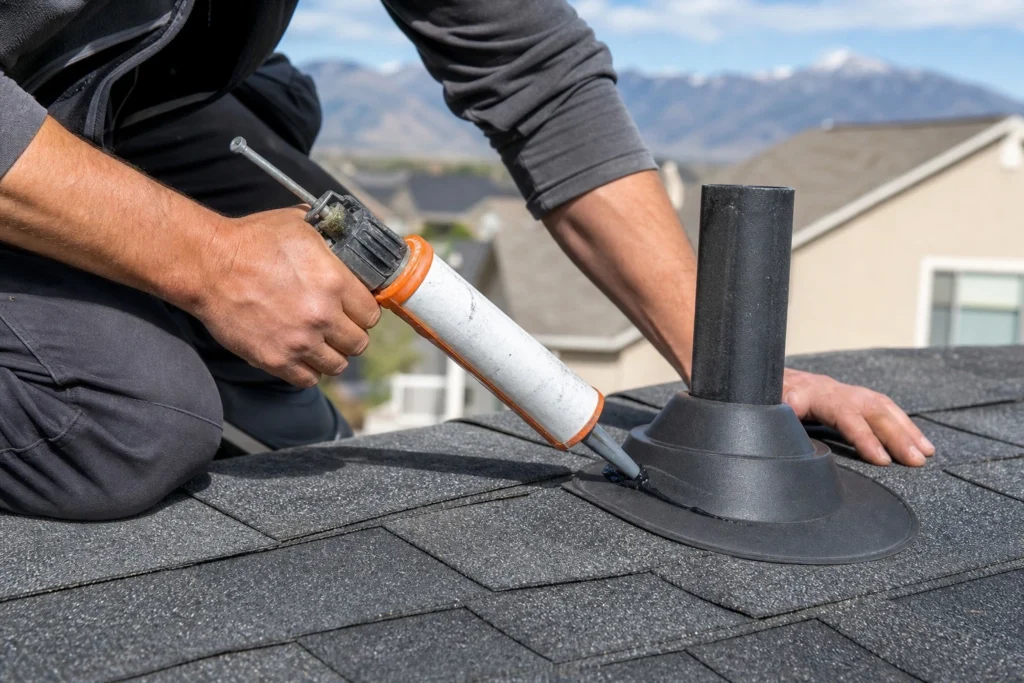
- Pipe Boot Deterioration — Rubber pipe boots around plumbing penetrations crack and shrink with age and UV exposure.
- Ridge and Hip Vulnerabilities — Ridge caps take the most weather exposure of any part of the roof. Deteriorated ridge cap shingles allow wind-driven water to enter.
- Skylight Seals — Skylights are a common source of leaks, typically at the flashing-to-frame connection.
- Clogged Gutters — When gutters are blocked, water backs up and pools at the roof edge, contributing to ice dam formation.
Roof Leak Repair vs. Roof Replacement
A repair is often the right call when the leak source is isolated, the roof is under 15 years old, and the underlying deck structure is sound. Replacement is worth evaluating when leaks are appearing in multiple locations, the roof is 20 years or older, or water damage has compromised the roof deck. The repair vs. replacement guide covers the key factors in detail.
When Insurance May Be Part of the Conversation — If the leak was caused by a storm, hail, or wind event, your homeowners insurance may cover the repair. See the insurance coverage guide for more detail.
Risks of Delaying Roof Leak Repair
- Roof deck rot — sustained moisture contact causes structural decking to deteriorate
- Insulation saturation — wet insulation loses its thermal value and becomes a moisture reservoir
- Mold growth — warm, damp attic conditions accelerate mold development
- Interior damage — water reaching ceilings, walls, and floors adds interior repair costs
- Structural compromise — long-term moisture in framing members weakens the structural integrity of the roof system
Can a Roof Leak Be Fixed Without Full Replacement?
In many cases, yes. Localized leaks caused by flashing failures, pipe boot deterioration, or isolated shingle damage can often be repaired without replacing the entire roof. The key is accurate diagnosis — a repair that addresses symptoms without identifying the true source will not hold long-term.
Can a Small Roof Leak Become a Bigger Problem?
Yes. Even a small leak can allow moisture into decking, insulation, drywall, and framing over time. Because water often travels along structural members before becoming visible inside the home, the amount of hidden damage may be greater than the size of the stain suggests.
What Affects Roof Leak Repair Costs?
Source of the Leak — A flashing repair or pipe boot replacement costs far less than addressing widespread shingle damage. Extent of Water Intrusion — If moisture has reached the roof deck, insulation, or interior structure, the repair scope expands. For typical repair cost ranges in Utah, see the roof repair cost guide.
Roofing Services in South Valley & Salt Lake County
- Roof Repair — broader structural and surface repairs
- Storm Damage Roof Repair — when the leak follows a weather event
- Roof Inspection — condition assessment before committing to repair
- Roof Replacement — when repair is no longer the right long-term answer
Homeowners in Sandy and Midvale can request a leak inspection through South Valley Roof Repair.
Request a Roof Leak Inspection in South Valley
If your roof is leaking or showing signs of water intrusion, the right next step is a professional inspection.