
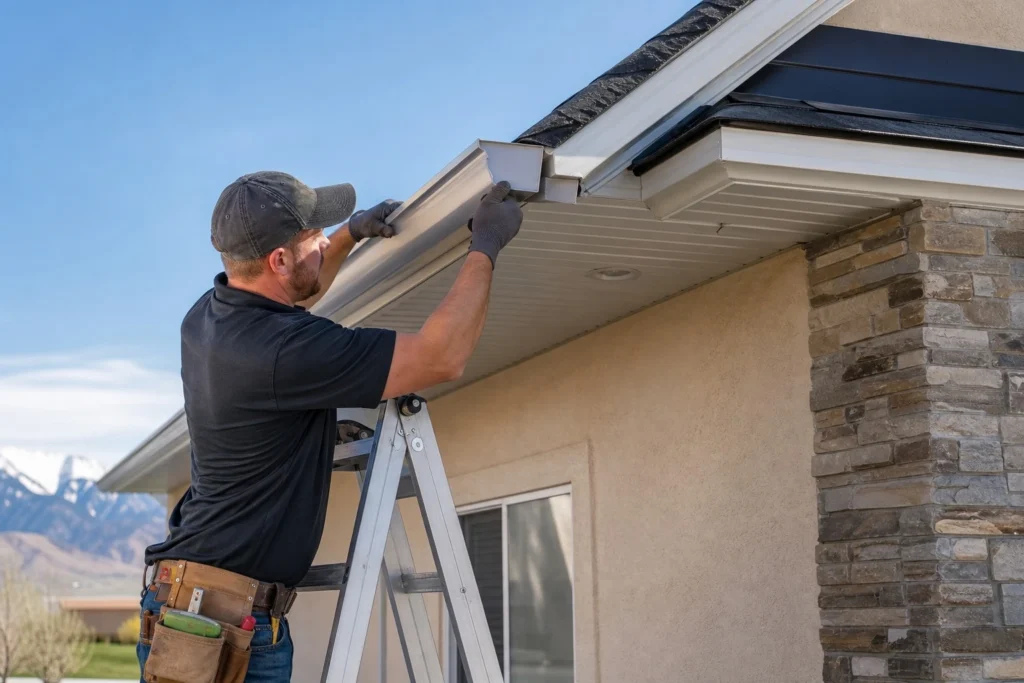
Gutters don’t get much attention until something goes wrong — and by then, the damage has often spread well beyond the gutters themselves. In South Valley and across Salt Lake County, gutters serve as a critical component of your roof’s water management system. Utah’s freeze-thaw winters, heavy spring rain events, and dry summers create conditions where both overloaded and neglected gutters cause real structural damage.
Failed gutters contribute to ice dams, fascia rot, foundation drainage problems, and basement moisture intrusion. If your gutters are sagging, separating, or overflowing during rain events, the issue is worth addressing before it becomes a roof or foundation problem.
Signs Your Gutters Need Repair or Replacement
- Water spilling over the gutter edge during rain (clog or pitch problem)
- Gutters pulling away from the fascia or separating at seams
- Visible rust, holes, or corrosion in steel gutters
- Fascia boards that appear soft, discolored, or rotting behind the gutters
- Standing water or erosion in the soil directly below the roofline
- Ice dam formation at the eave during winter
- Downspouts that drain directly against the foundation
Why Utah Roofs Require Special Attention to Gutters
Salt Lake County’s seasonal pattern is particularly demanding on gutters. Winter snowmelt generates sustained water flow during warming cycles. If gutters are clogged or misaligned, that meltwater backs up under shingles or refreezes at the eave — contributing to ice dam formation. Spring rain events in South Valley can be intense and brief, overwhelming gutters that are partially clogged or undersized.
Gutter Options for South Valley Homes
Sectional Gutters — Joined in sections at seams. Lower material cost. Seams are the primary failure point — they can separate under ice load or with UV aging. Common in older Salt Lake County homes.
Seamless Gutters — Fabricated in a single continuous run on-site. No seams along the horizontal run — only at corners and downspout connections. The dominant choice for new installations in South Valley. Significantly reduces leak potential. Aluminum is the standard residential choice — lightweight, rust-resistant, and available in colors matched to fascia.
K-Style vs. Half-Round — K-style is the current standard in most residential installations — higher water capacity than half-round at the same width. Half-round is a traditional profile often used on older homes.
Gutter Guards — Mesh or micro-mesh guards reduce debris accumulation and extend the cleaning interval. In Utah, where cottonwood seed and leaf debris can clog gutters quickly, guards are worth evaluating — particularly on homes with significant tree canopy.
Repair vs. Replace — Decision Framework
Repair is appropriate when damage is localized, the overall gutter is less than 10 years old, and the fascia behind it is sound. Replacement is the better path when gutters are sectional and multiple seams are failing, the fascia shows rot or moisture damage, or the system is undersized for the roof’s square footage. See the roof repair guide and roof repair vs. replacement guide for related scope considerations.
Insurance Considerations
Gutter damage from storm events — wind, hail, falling branches — may be covered under your homeowners policy. Deterioration from age or neglect is not. If a storm event damaged both your roof and gutters, document both in the same inspection report. See the insurance coverage guide for claim documentation guidance.
Do Gutters Cause Ice Dams in Utah?
Yes, clogged or misaligned gutters contribute to ice dam formation. When gutters can’t drain snowmelt, water backs up and refreezes at the eave — eventually forcing water under shingles and into the roof structure.
Should I Replace Gutters at the Same Time as My Roof?
Often yes. New roofing installation typically requires removing and re-hanging gutters. If gutters are nearing end of life, replacing them during the same project avoids double labor cost and ensures the complete water management system is reset at the same time.
Gutter Installation & Repair — Frequently Asked Questions
How often should gutters be cleaned in South Valley? Twice per year is the standard recommendation — once in late spring after cottonwood season and once in late fall after leaf drop. Clogged gutters during winter are a primary ice dam risk factor in Salt Lake County.
What size gutters do South Valley homes typically need? Most single-story South Valley homes use 5-inch K-style gutters. Larger homes or steeper pitches may benefit from 6-inch gutters.
How long do aluminum gutters last in Utah’s climate? Well-installed seamless aluminum gutters typically last 20–30 years in Salt Lake County conditions.
Related Services
Serving Taylorsville and Murray homeowners with gutter installation and repair.
Gutters That Aren’t Draining Properly Put Your Roof at Risk
Request a free roof inspection — a roofing professional will evaluate your gutters, fascia, and roof edge as a complete system.