
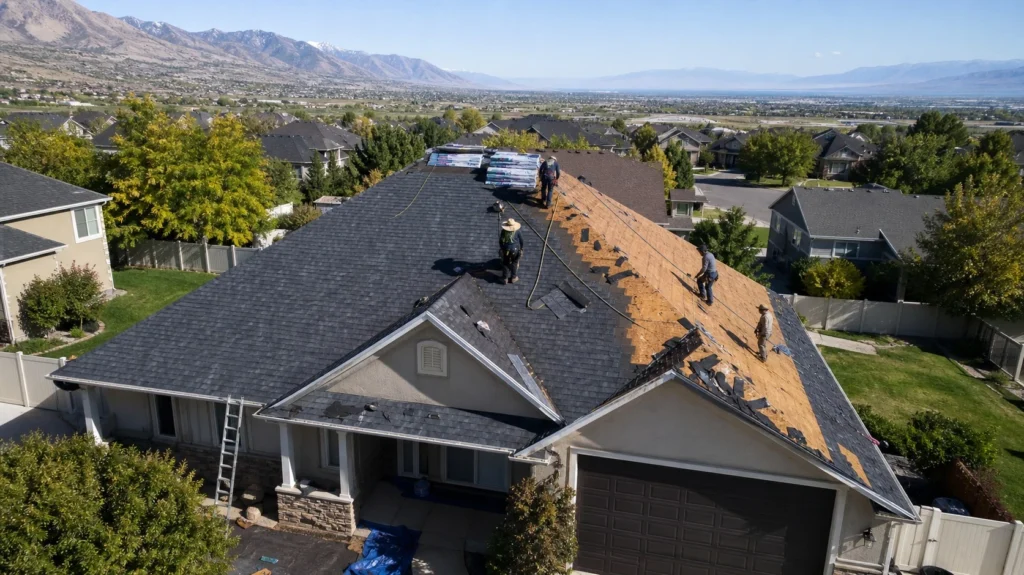
A roof replacement is one of the most significant home improvement decisions a Utah homeowner can make. The right material, installation, and timing can protect a home for 25 to 50 years depending on what you choose. The wrong decision, or delaying too long, can lead to structural damage that extends well beyond the roof itself.
South Valley Roof Repair connects homeowners across South Valley and Salt Lake County with local roofing professionals who can assess whether replacement is the right call, explain material options suited to Utah conditions, and carry the project from evaluation to completion.
Signs Your Roof May Need Replacement
- Roof is 20 years or older and showing widespread wear
- Multiple leaks appearing in different locations
- Shingles are curling, buckling, or missing in large sections
- Significant granule loss visible in gutters or downspouts
- Roof deck is soft, spongy, or visibly sagging
- Daylight visible through the attic ceiling
- Repeated repairs have not resolved recurring leaks
- Storm or hail damage is widespread across the entire roof surface
Why Utah Roofs Require Special Attention
Accelerated UV Degradation — South Valley sits at elevation, where UV radiation is more intense. Asphalt shingles degrade faster in high-UV environments, which can shorten the effective lifespan compared to manufacturer estimates.
Freeze-Thaw Stress — Repeated temperature swings between freezing and above-freezing accelerate material fatigue. A roof nearing the end of its lifespan handles freeze-thaw cycles less effectively.
Snow Load and Ice Dams — Heavy snowpack adds significant weight to a roof structure. Combined with ice dam formation at the eaves, an aging roof faces conditions that can accelerate failure.
Hail Frequency — The Salt Lake Valley experiences regular hail events. A roof that has absorbed multiple hail seasons may have cumulative damage that makes replacement more cost-effective than continued repair.
Roof Replacement Options for Utah Homes
Asphalt Shingles — The most widely used roofing material in Utah. Available in 3-tab and architectural styles, with lifespans typically ranging from 20 to 30 years. Cost-effective and widely available. Learn more about asphalt shingle roofing.
Metal Roofing — Standing seam and metal shingle systems offer lifespans of 40 to 50 years or more, with strong performance under snow load and UV exposure. Higher upfront cost, lower long-term maintenance. See the metal roofing page for more detail.
Architectural / Impact-Resistant Shingles — Class 4 impact-resistant shingles are worth considering in hail-prone areas. Some Utah homeowners insurance policies offer premium reductions for impact-resistant roofing.
Roof Replacement vs. Roof Repair — How to Decide
Lean toward repair when damage is isolated to a small area, the roof is under 15 years old, the underlying deck structure is sound, and there are no recurring leaks in multiple locations.
Lean toward replacement when the roof is 20+ years old with widespread wear, repairs are recurring, hail or storm damage is extensive, or the roof deck shows signs of rot. For a detailed walkthrough, see the roof repair vs. replacement guide.
When Insurance May Be Part of the Conversation — If your roof damage was caused by a storm, hail, or high winds, your homeowners insurance policy may cover some or all of the replacement cost. See the insurance coverage guide for more on what Utah homeowners can typically expect.
Risks of Delaying Roof Replacement
- Decking damage — prolonged moisture exposure rots the structural decking beneath the shingles, expanding the scope and cost of the project
- Insulation damage — water intrusion saturates attic insulation, reducing thermal performance
- Interior water damage — leaks reach ceilings, walls, and floors, adding interior repair costs
- Mold growth — moisture in attic spaces and wall cavities creates conditions for mold
- Higher eventual costs — the longer replacement is deferred, the more secondary damage accumulates
What Affects Roof Replacement Costs?
Roof Size — Cost is typically calculated per square (100 square feet). Larger roofs cost more in both materials and labor.
Roofing Material — Asphalt shingles are the most affordable option. Metal and premium architectural shingles carry higher material costs.
Roof Pitch and Complexity — Steeper pitches and complex roof lines with multiple valleys, hips, and penetrations require more time and labor.
Tear-Off and Disposal — Removing existing roofing layers adds cost. Some roofs can accept a second layer without tear-off, though this varies by local code and roof condition.
For typical replacement cost ranges in Utah, see the roof replacement cost guide.
Roof Replacement — Common Questions
How long does a roof replacement take? Most residential roof replacements are completed in one to two days for standard-sized homes. More complex roofs may take longer.
Can hail damage justify a full roof replacement? Yes, in some cases. Widespread hail damage that affects a large portion of the roof surface may make replacement more cost-effective than patching multiple sections.
Will my insurance cover roof replacement? It depends on the cause. Storm and hail damage is commonly covered. See the insurance coverage guide for more detail.
Roofing Services in South Valley & Salt Lake County
- Roof Repair — when replacement isn’t necessary
- Roof Inspection — establish condition before committing to any decision
- Metal Roofing — durable long-term alternative to asphalt
- Asphalt Shingle Roofing — most widely used material in the Salt Lake market
Homeowners in Draper and Riverton can request a roof replacement evaluation through South Valley Roof Repair.
Request a Roof Replacement Estimate in South Valley
If your roof is aging, showing widespread damage, or you’ve had recurring leaks that repairs haven’t resolved, a replacement evaluation is the right next step.